
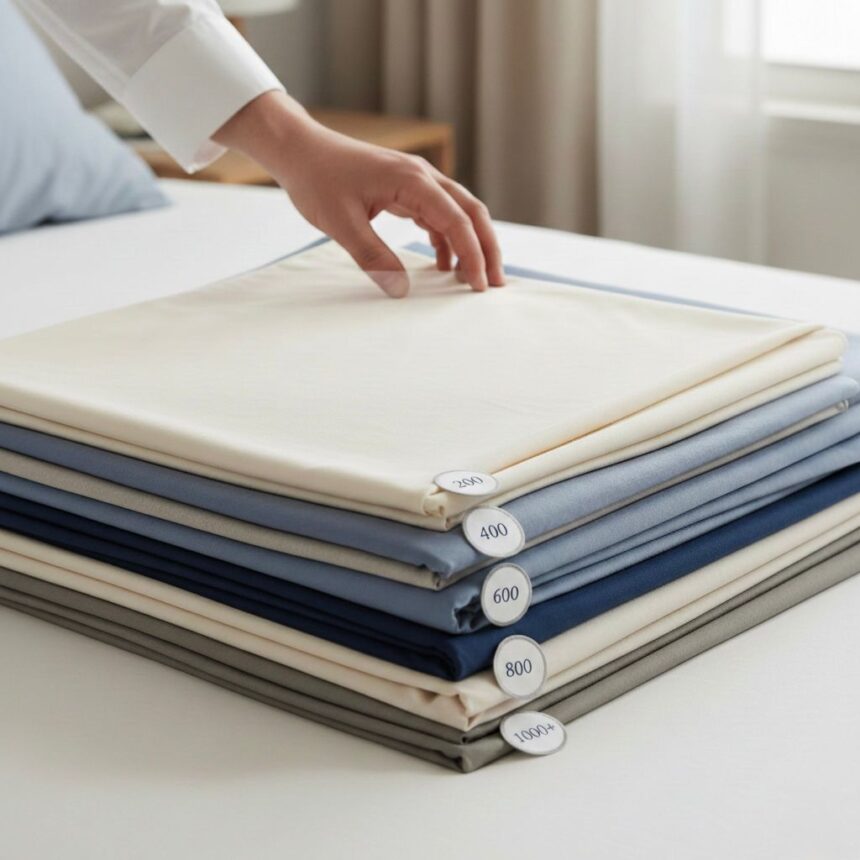
We’ve spent hundreds of hours scrutinizing and sleeping on dozens of cotton sheet sets, and we know from experience that manufacturers sometimes game the thread counts, doubling the numbers to make their sheets seem more luxurious. According to the many experts we’ve interviewed, really good sheets– the ones that feel soft and wear well after years of use and washing– generally have thread counts ranging from 200 to 600, depending on whether they’re percale or sateen. But honestly, thread count isn’t the most important thing to consider. A lot of other factors– such as the type of cotton and yarns the sheets are made from– are more important in picking a soft, long-wearing set.
“When it comes to thread count, most people forget that the quality of threads is far more important than the quantity.” What Is a Good Thread Count for Sheets– Missy Tannen, co-founder of Boll & Branch”
Preethi Gopinath
Preethi Gopinath, director of the Textiles MFA program at Parsons, and Shannon Maher, chairperson and assistant professor of the Home Products Development department at the Fashion Institute of Technology (at the time of the interview), both weighed in on the best thread counts for each weave:
Percale
- Gopinath said a 250 to 300 thread count was optimal (there’s wiggle room, though, as Maher said 200 was also good).
- Gopinath told us a 400 to 500 thread count for percale could reflect a denser sheet made of fine, good-quality yarns. Over 500 was “not necessary or likely,” she said.
- Average-quality percale hovers around 180.
Sateen
- Gopinath and Maher agreed that good-quality sateen sheets ranged from 300 to 600 thread count. The number could creep higher, but this would create a very heavy sheet.
- Average-quality sateen ranges from about 250 to 300.
Judging from our testing experience, we think those ranges are pretty spot-on. Cotton sheets guide, our favorite percale set (L.L.Bean’s 280-Thread-Count Pima Cotton Percale Sheet Set) has a 280 thread count. Both of our top sateen recommendations (the JCPenney Home 400 TC Wrinkle Guard Sheet Set and Cuddle down’s 400 Thread Count Cotton Sateen Bedding) are 400 thread count– which, incidentally, Maher noted, was her ideal number for sateen. “Thread count really measures fabric density,” said Missy Tannen, co-founder of Boll & Branch. “Too high of a thread count means that air doesn’t circulate well and you’ll sleep hot.” Percale thread counts are lower simply because the plain weave allows for fewer threads in a square inch. Organic cotton crib sheets Gopinath told us this made percale lighter and cooler, which is preferable in hotter temperatures or for hot sleepers. Sateen, with its higher thread counts (that is, more densely packed yarns), tends to be softer but also heavier than percale. A higher thread count is more important for sateen because it reduces the likelihood of snagging the longer floats– the weft yarns that skim across several warp yarns.
Higher-thread-count sheets
Higher-thread-count sheets are made with finer (thinner) yarns. The more yarns that fit into a square inch, the smoother, denser, and more durable the fabric. Fine yarn is also more expensive to produce, thus resulting in pricier sheets (and why densely woven sateen is more expensive than percale). Cheap sheets are made with thicker yarns, resulting in lower thread counts and a rougher feel. The best yarn is made from long-staple or extra-long-staple (ELS) cotton; longer threads of cotton fiber in each yarn help those alternating warp and weft yarns stay smooth and flat. (You can read a longer explanation of this topic in our post about whether Egyptian-cotton sheets are worth splurging for.) That’s why long-staple cottons, including pima, Supima, and sometimes Egyptian-cotton fabrics are considered more luxurious. Maher also recommended looking for sheets made from combed cotton; in this process manufacturers comb out debris and too-short fibers from the cotton before spinning it into yarn that can weave into softer, smoother, and more durable fabric.
Conclusion
Even the print on sheets can indicate something about the quality of the fabric. Maher and Gopinath both told us that printed sheets were typically produced on lower-thread-count percale cotton to keep costs down. When manufacturers invest in a higher thread count for sheets, they don’t want to cover up that texture. “You want that to be the selling point,” Gopinath said. Print is “a cheap way of applying pattern,” Gopinath told us, an alternative to actually weaving a design into the fabric, like with a damask or jacquard. Next time you’re shopping for sheets, instead of agonizing over the thread counts, first decide whether you want percale or sateen, and then stay within the established ranges that we covered above. Focus on the quality of the cotton instead of the thread count. As Vicki Fulop, co-founder of Brooklinen, told us, “Thread count certainly matters, but it’s not the only thing that matters.”